Oct 29

The MiNT Academy: Research Impact Report 2026

The MiNT Academy: Research Impact Report 2026

Background

Neurorehabilitation technology is a growing and exciting field of development in healthcare. In order for this technology to ultimately change lives, input from clinicians and people with lived experience along the entire development journey is essential. 

In response to this need, The MiNT Academy was created, with real-world application and patient benefit as the central motivation. Since 2019, The MiNT Academy has supported successful journeys for neurotechnology - from early development and testing, through to adoption. The MiNT Academy is the innovation, research and development arm of Hobbs Rehabilitation.

With such depth and breadth in our Hobbs Rehabilitation team of over 100 specialist clinicians, we have hand-picked a dedicated team at The MiNT Academy. This team consists of seven clinicians across disciplines who have extensive specialist experience in neurorehabilitation and have worked in a variety of national and international research capacities. This includes research roles in leadership, delivery, collaboration, scientific authorship, and international dissemination.

This report takes a look back at what The MiNT Academy has achieved over the past 6 years and provides an overview of how it has had an impact on the following six key areas: 
  1.  Research Delivery
  2. Collaboration and Consultancy
  3. Building Research Workforce and Capacity
  4. Patient Involvement
  5. Commercial Outcomes
  6. Knowledge Production and Dissemination

Research Delivery

Since 2019, MiNT has been building the infrastructure required for efficient research delivery. Figure 1 demonstrates how our capacity for research delivery has grown over this time, successfully recruiting participants to 12 clinical studies. 
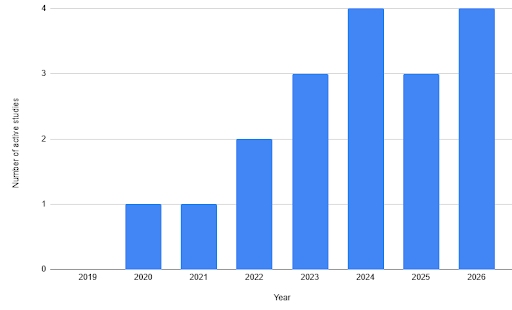
Figure 1: Number of active recruiting studies per year.
The agile nature of MiNT has often meant that recruitment and data collection can be expedited, delivering research more efficiently and at a greater pace than other clinical partners. This has enabled studies to recruit more quickly and to meet targets. For example, we have been able to reach government research delivery targets, such as opening within 60 days of successful ethics review, and recruiting our first patient 20 days after staff study training was completed- see the blog of this study here.

Collaboration and Consultation

At the heart of MiNT has been the aim to collaborate and bridge key gaps between engineers, clinicians, and patients. By providing a high-quality and structured approach to consultancy and collaboration, MiNT has bridged these gaps, ultimately improving the chances that developing technologies will become effective for rehabilitation. 

The following testimonials from neurotechnology companies demonstrate the impacts of MiNT’s consultancy model: 
"The MiNT Academy team is professional in their communication and offers valuable insights into stroke rehabilitation from diverse perspectives. Their honest feedback and probing questions helped uncover in-depth insights from stroke survivors. We hope to conduct more co-design sessions with MiNT and stroke survivors to create a product that truly meets their needs”. 


Orion Dai, Design Engineer - Omnihuman

“Working with The MiNT Academy has enabled us to have conversations we simply couldn’t have had otherwise: direct, honest input from clinicians who work with stroke patients every day. Their clinical expertise and collaborative approach have challenged our assumptions and pushed us to think differently about what our technology actually needs to do in a real rehabilitation setting.”


Allan Ponniah, CEO - COGITAT

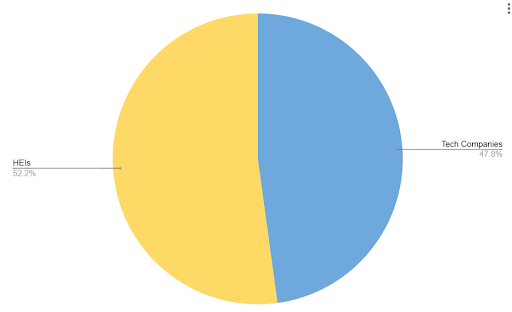
MiNT has enjoyed working with over 23 formal collaborations. Figure 2 provides an overview of our main collaborators: Higher Education Institutions (HEIs) and Technology Companies.
Figure 2. Pie chart showing an overview of MiNT’s collaborators.
Through formal consultancy, MiNT have worked at the pre-application stage of 11 research projects and throughout the lifecycle of two other projects. 

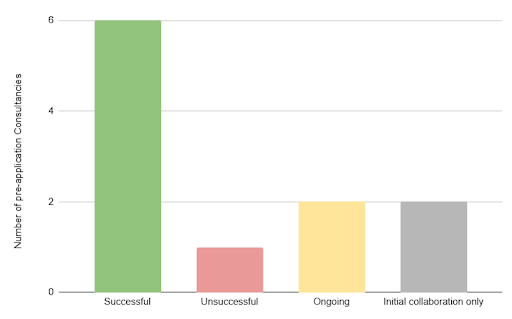
Of the pre-application consultations, Figure 3 provides details regarding the project outcomes in terms of funding success. 
Figure 3. Graph showing the outcomes of projects which undertook pre-application consultations with MiNT
This year, MiNT held its first researcher collaboration day, where academics in neurorehabilitation congregated to discuss future research collaboration opportunities. Growing and strengthening these relationships will form part of MiNT’s future directions for research collaboration. 

Also forming a key part of MiNT’s future plans for collaboration is the recently launched CREATe Consortium.  CREATe is led by The MiNT Academy and co-founded alongside Hobbs Rehabilitation (UK), therapy2people (t2p) (Austria), and Centro Europeo de Neurociencias (CEN) (Spain). These founding partners bring extensive experience in neurorehabilitation, clinical innovation, and technology implementation. Their shared ethos reflects a collective commitment to evidence-based practice, global collaboration, and patient-centred advancement. With different specialist clinical centres across the globe collaborating on this exciting new alliance, it will provide the structure and momentum needed to improve rehabilitation outcomes for people living with neurological conditions in a truly meaningful way.

Building Research Workforce and Capacity

MiNT’s development of Allied Health Professional (AHP) workforce directly aligns with Health Education England’s (HEE) ‘Allied Health Professions’ Research and Innovation Strategy for England’ (HEE, 2022). MiNT has worked towards the core domains described in the strategy  (HEE, 2022), growing the right skills, context, and culture for research activity to thrive. 

In a UK landscape where substantive clinical-research roles for AHPs are rare (Sutton et al. 2026), MiNT has developed and sustained substantive clinical-research contracts through its direct affiliation with the overarching company, Hobbs Rehabilitation,  making it a relatively unique environment for UK-based AHPs to work within and pursue dual roles. 

There are now three research-active sites spread across the south of England. (Figure 4).
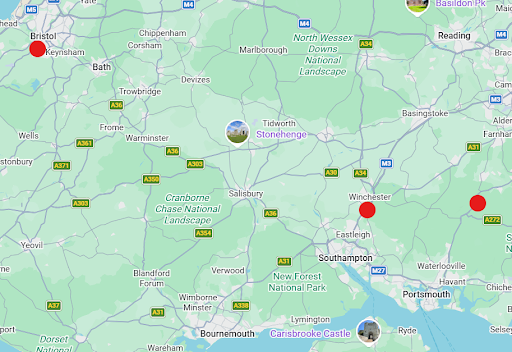
Figure 4. Current research-active sites: Liss, Winchester, and Bristol.
MiNT has developed 17 research active clinicians across these sites. These clinicians have grown their skills in practical research delivery such as recruitment, intervention delivery, data collection, and following Good Clinical Practice (GCP) guidelines, with multiple members of staff completing their formal GCP training. Exposure to research activity at MiNT has also been an opportunity for personal career development and advancement of clinical skills.  Examples of these experiences can be found in the  following  testimonials from some of our research-active staff: 

“This experience has strengthened my understanding of neurorehabilitation and the role of innovative technologies. I have improved my ability to communicate effectively with patients when explaining novel interventions. It has supported my professional development by giving me insight into the research process and reinforcing the importance of outcome-driven care. For my patients, it has provided access to engaging and structured rehabilitation approaches, while allowing progress to be measured objectively using validated tools”. 

Junior Physiotherapist - Hobbs Rehabilitation

“I have developed an understanding of clinical trial pathways, strengthened my knowledge of data collection methods, and increased my understanding of research governance and regulatory requirements through completion of Good Clinical Practice (GCP) training. It's been a fantastic opportunity to work in research, as it is difficult to get into without an academic background. For patients, it has been an opportunity for increased therapy, trialling devices before they are normally available, involvement and voice in innovation”.

Specialist Occupational Therapist - Hobbs Rehabilitation

Many more clinicians across the organisation have had their awareness and knowledge of evidence-based practice enhanced through interactions and learning from the MiNT Academy. The MiNT Academy has also delivered other research training events to clinical staff on topics such as abstract writing for conference poster submissions. 

Patient Involvement

The MiNT Academy’s position within the neurorehabilitation clinical service, Hobbs Rehabilitation, enables constant and direct interaction with patients and their families and is central to the organisation. Studies show that by embedding research into healthcare systems, patients benefit from better health outcomes, increased treatment adherence, and less healthcare use (NIHR).

MiNT has ensured that patients and families are involved and formally consulted alongside clinicians when developing and testing new technologies. It has also provided opportunities for patients to be involved in clinical trials and exposure to new rehabilitation devices. The following are comments made by patients who have collaborated with MiNT projects:

“Go for it! The more input, the better. It could really make a difference to somebody in the future. Research probably needs to have the widest range of people with differing abilities, ages, etc”

“... I wasn’t really sure what to expect, so a bit apprehensive ... but the staff were great, so I was able to relax into the session.”

“It sounded very interesting ... And potentially could see the benefits it might give others in the future”

To date, MiNT has successfully made 140 recruitments across the research portfolio. It has grown a database of 434 people who have signed up to be informed about opportunities to participate in future clinical research. These people are living with a range of different conditions such as stroke, multiple sclerosis, Parkinson’s Disease, Vestibular dysfunction, concussion, tumours, functional neurological disorders, and a wide range of other neurological diagnoses affecting the brain and spinal cord.

Commercial Outcomes

In order to bridge the gaps in the pipeline from development to patient benefit, MiNT has also supported developers to navigate the journey to commercialisation. This has included providing strategic guidance on market access, regulatory pathways, clinical validation, and routes to adoption within healthcare systems. By connecting innovators with clinical expertise, industry partners, and end-users, MiNT has helped ensure that promising technologies are not only developed, but positioned for successful real-world implementation.

Through this support, developers have been better equipped to refine their value propositions, generate meaningful evidence, and align product development with the needs of patients, clinicians, and healthcare providers. This collaborative approach has accelerated the translation of innovation from concept to clinic, enabling solutions to reach the people who can benefit from them most, while also fostering sustainable commercial growth and long-term impact across the rehabilitation technology sector.

Through this work, six technology companies now have commercially available devices.
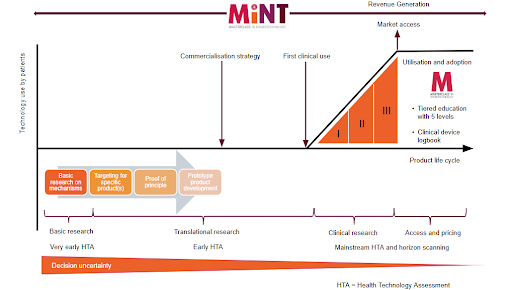
Figure 5 below provides an example of the journey through all TRL levels, which is supported by MiNT.
Figure 5: Journey to commercialisation.

Knowledge Production and Dissemination

MiNT has contributed to and/or authored multiple scientific publications, but has also been passionate about knowledge dissemination - sharing and educating about the advances in neurotechnology. This has included the presentation of posters and podium presentations at multiple national and international conferences.

Internationally, MiNT was invited to run a track of presentations at RehabWeek in 2022 and was invited back as a conference partner for two subsequent years, most recently in Chicago. These successful international collaborations continue with plans to partner as a core society for the next RehabWeek in Switzerland in 2027.  Also on the global stage, MiNT have presented their work at The World Congress for Neurorehabilitation (WFNR) and the European Federation of NeuroRehabilitation Societies (ECNR). Podium presentations have been delivered at the British Society of Physical and Rehabilitation Medicine (BSPRM) conference in 2025 and at the British Association of Brain Injury and Complex Case Management (BABICM) conference in 2026.

Whilst making these contributions, MiNT has also started leading its own specialist neurotechnology conferences in the UK. Over three consecutive years, these conferences have enabled the clinical, scientific, and commercial communities to connect and share learning. Figure 6 below shows the steadily increasing number of delegates attending each year, and Figure 7 shows the breakdown of delegate types at the most recent conference in 2025.
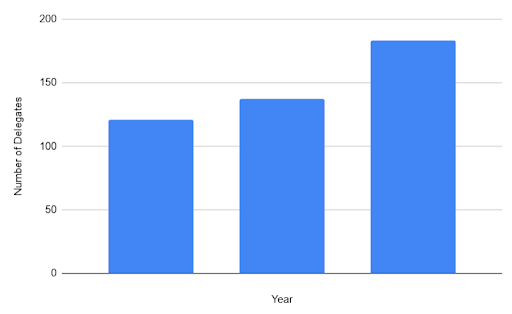
Figure 6. Delegate numbers at MiNT UK Conference per year: 2023, 2024, 2025.
All publications and posters can be viewed here.

Future Directions for MiNT:

Over the next 3-5 years, MiNT will continue to grow in six key areas outlined in this report:

  1. Research Delivery
  2. Collaboration and Consultancy
  3. Workforce Development
  4. Patient Involvement
  5. Commercial Success
  6. Knowledge Production and Dissemination

Research Delivery

MiNT will continue to develop its Research and Development infrastructure to facilitate the entire research life cycle, and expedite the production of high-quality clinical evidence. This will include further development and streamlining of the research pipeline and associated processes, as well as further training and capacity-building (see workforce development). 
  • Increase our number of studies running to five per year.

Collaboration and Consultancy

MiNT will continue to build upon its successful consultation model, aiming to increase the volume of consultancy work in order to ensure that neurotechnology is increasingly designed to optimise clinical application. 

It is also vital that collaborations continue to grow in order to both reduce duplication of effort within the neurorehabilitation community and to enhance the overall outcomes for all organisations involved, aiming to ensure that ‘the whole is greater than the sum of the parts’. This growth will include closer liaison with the NIHR, HEIs, and the NHS to ensure that research is both innovative and aligned with national priorities.

Internationally, MiNT will continue to build and develop the CREATe Consortium. Whilst widening its reach within Europe, it will also develop work with CREATe's newest member in Australia. This enables MiNT to increase its global reach and further improve the efficiency of progress in neurorehabilitation by working and sharing internationally.

  • Continue developing consultancy packages and maintain our current number of annual consultancies.
  • Maintain a conversion rate of 50% or more into successfully funded projects.
  • Increase our collaboration with third parties to include them as part of a consultancy process. 

Workforce Development

In conjunction with the further development of research infrastructure, clinical staff will continue to be supported to develop research skills and knowledge. This will include increasing the number of GCP-trained staff, increasing opportunities for involvement in research studies, and educational events. MiNT will also support academic research qualifications for its workforce, with the first team member commencing a Master's in Research study in 2026. 
  • Double the number of GCP-trained staff. 

Patient Involvement

Patient involvement will remain at the centre of MiNT. MiNT will continue to grow the number of patients on the research database; we will further develop a clearer pathway via the website and research consent form, highlighting different ways people can get involved, including in-person and virtual opportunities, questionnaires/surveys. This means that more people will be offered opportunities to be involved in research as a participant, but also to shape the research itself and to directly inform the development of neurotechnology.

MiNT will also develop its internal PPIE resources and processes. In order to do this in the best way, we will be establishing a group of PPIE advisors, enabling those with lived experiences to steer and improve our PPIE work internally and externally. We will also work with relevant colleagues to agree how study findings can be shared more routinely with patients and the wider public, including exploring the publication of study results and plain English research summaries on the MiNT website within 12 months of study completion as per Health Research Authority guidance.

Commercial Success

MiNT will continue its successes with commercialisation, primarily by providing specialist and timely support when needed at pivotal points during the journey to market. It will increase its reach for collaboration - both in the UK and internationally. Partnering at the 2027 RehabWeek in Switzerland, and continued investment in the CREATe consortium are both examples of how MiNT will establish collaborations to achieve commercial success. MiNT provides a unique, efficient, and agile infrastructure for international collaborations to thrive and achieve success in the UK market. This will be a focus for further resources and development over the coming years.

Knowledge Production and Dissemination

MiNT will maintain representation at key national and international neurorehabilitation events. Patients and clinical application remain at the heart of MiNT, and it is therefore a priority that innovation and knowledge gained through its work are shared widely in an accessible way. MiNT will be working with collaborators to ensure that research trials produce patient-friendly dissemination materials about trial outcomes, and that these are shared with trial participants in a variety of accessible ways. 

MiNT is passionate about taking time and effort to disseminate work, so that real-world clinicians are able to translate knowledge into practice. This will involve continued close collaboration with MiNT education to optimise implementation and adoption at a clinical service level.

Limitations of this Report:

This data was gathered retrospectively from a variety of documents and sources from the MiNT Academy Archives and therefore may contain some unintended inaccuracies. 

References

Health Education England (2022) ‘Allied Health Professions’ Research and Innovation Strategy for England’ available at HEE Allied Health Professions Research and Innovation Strategy  [Last accessed June 2026]. 

NIHR ‘Embedding a research culture | NIHR’  [Last accessed June 2026].

Sutton J, Ward G, and Roddam H (2026)  ‘Securing the future of AHP research: mapping UK practitioner-academic/clinical-academic roles and sustainability’ BMC Health Services Research 26:12.

https://themintacademy.co.uk/blog/maximise-your-neurotechnology-development-the-mint-academys-clinical-consultancy-packages
https://themintacademy.co.uk/blog/pushing-boundaries-in-neurorehabilitation
https://themintacademy.co.uk/blog/an-innovators-journey-neubond
https://themintacademy.co.uk/blog/case-study-valkyrie-eir-bands-in-upper-limb-rehabilitation
https://themintacademy.co.uk/blog/bringing-valkyrie-industries-cutting-edge-tech-to-neurorehab-at-hobbs-rehabilitation
https://themintacademy.co.uk/blog/introducing-create
https://themintacademy.co.uk/blog/cogimotion-single-session-feasibility-study
Created with